What is Europa Clipper?
- Nick G

- Jul 19, 2022
- 3 min read
Written By Nick G For AeroSpace001
NASA's Europa Clipper Mission (previously known as Europa Multiple Flyby Mission), is an interplanetary mission currently in development by NASA/JPL and the John Hopkins Applied Physics Lab.
Background
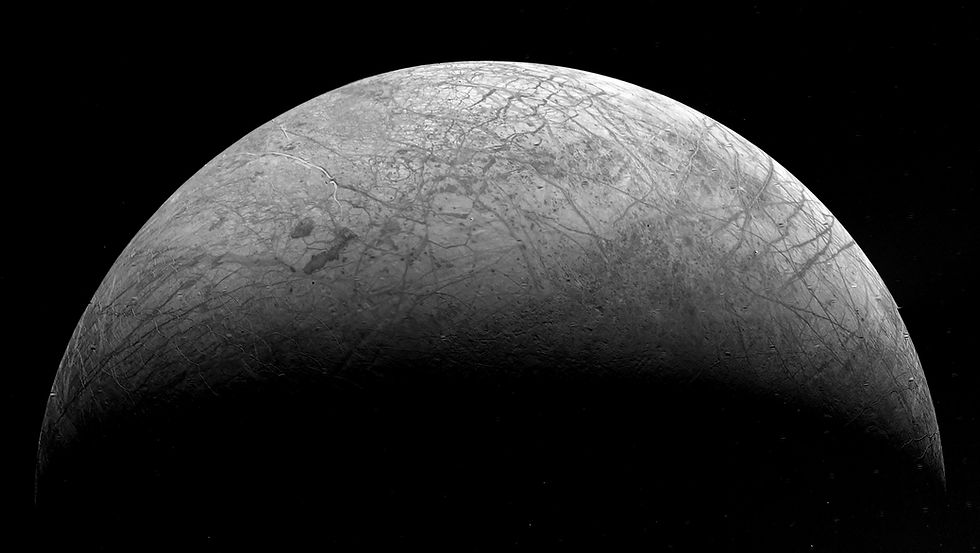
Europa was discovered in 1610 by Italian astronomer Galileo Galilei with his homemade telescope. His discovery shocked the world, at this time it was thought that the universe rotated around the earth. But Galileo's discovery of Europa and the other three Galilean moons showed that the earth was not the center of attention in the universe. The name Europa comes from Greek Mythology for a woman who was abducted by Zeus.
We know from the six robotic spacecraft that made fly-bys of Europa, including Voyagers 1 and 2 and the Galileo orbiter. The Galileo orbiter provided the strongest evidence that Europa has a liquid ocean below its icy surface. Scientists revisited old Galileo data and found evidence Europa may be venting plumes of water vapor into space. The Hubble Space Telescope has also seen engaging proof of plumes on Europa.
The Spacecraft

Europa Clipper's power will come from solar arrays each about 190sq ft and providing 150 watts continuously when pointed towards the Sun while orbiting Jupiter. While in Europa's shadow, batteries will enable the spacecraft to continue gathering data. This will enable it to gather data on almost the entire moon. Europa Clipper's orbit will pass through Jupiter's intense magnetosphere which can degrade the arrays

Before we can talk about the instruments we need to talk about the science questions. Below are the science questions outlined by NASA:
Does Europa really contain an ocean beneath its shell of ice?
How deep is the ocean?
Does the chemistry of the ocean seem friendly for microbes?
Is Europa’s ice shell active, allowing surface material to migrate to the ocean and vice versa, perhaps enriching the ocean with molecules from above that could serve as "food" for organisms?
Europa Clipper will carry 10 science instruments. Cameras (1 visible light, 2 infrared light) and spectrometers will create high-resolution images and composition maps of the moon's surface and thin atmosphere. An ice-penetrating radar, a magnetometer, plasma sensors, and a gravity investigation will reveal the moon’s ocean and deep interior. The spacecraft's thermal camera will pinpoint warmer ice and might show recent eruptions of water. A dust analyzer and a mass spectrometer will study the chemistry of particles in space near the moon.
Launch and trajectory

It was originally planned that Europa Clipper launches on NASA's SLS (Space Launch System). Then in July 2021, Falcon Heavy was chosen to launch the spacecraft. But there were three main things that NASA was worried about with launching on SLS. One was the vibrations from launching on a rocket with SRBs (Solid Rocket Boosters) building the spacecraft to that standard was estimated to cost NASA around US$1 billion, Number 2 was due to the availability of SLS because it is the launch vehicle for the Artemis program (NASA's program to take humans back to the moon), and the third reason for the switch is launch cost switching to Falcon Heavy saved NASA an estimated US$2 billion. The only downside is not using SLS adds for about 3 years to get into Jupiter's orbit.
Do you think Europa Clipper will find water?
Yes
No
If you like these types of articles and want more like these, you can become a member of our website and channel where you get exclusive posts, and photos! We also make lots of educational YouTube videos for you to learn the most content possible! Thank you to all of our supporters that make this possible! P.S Rockets Weekly is back on AeroSpace001!


Comments